
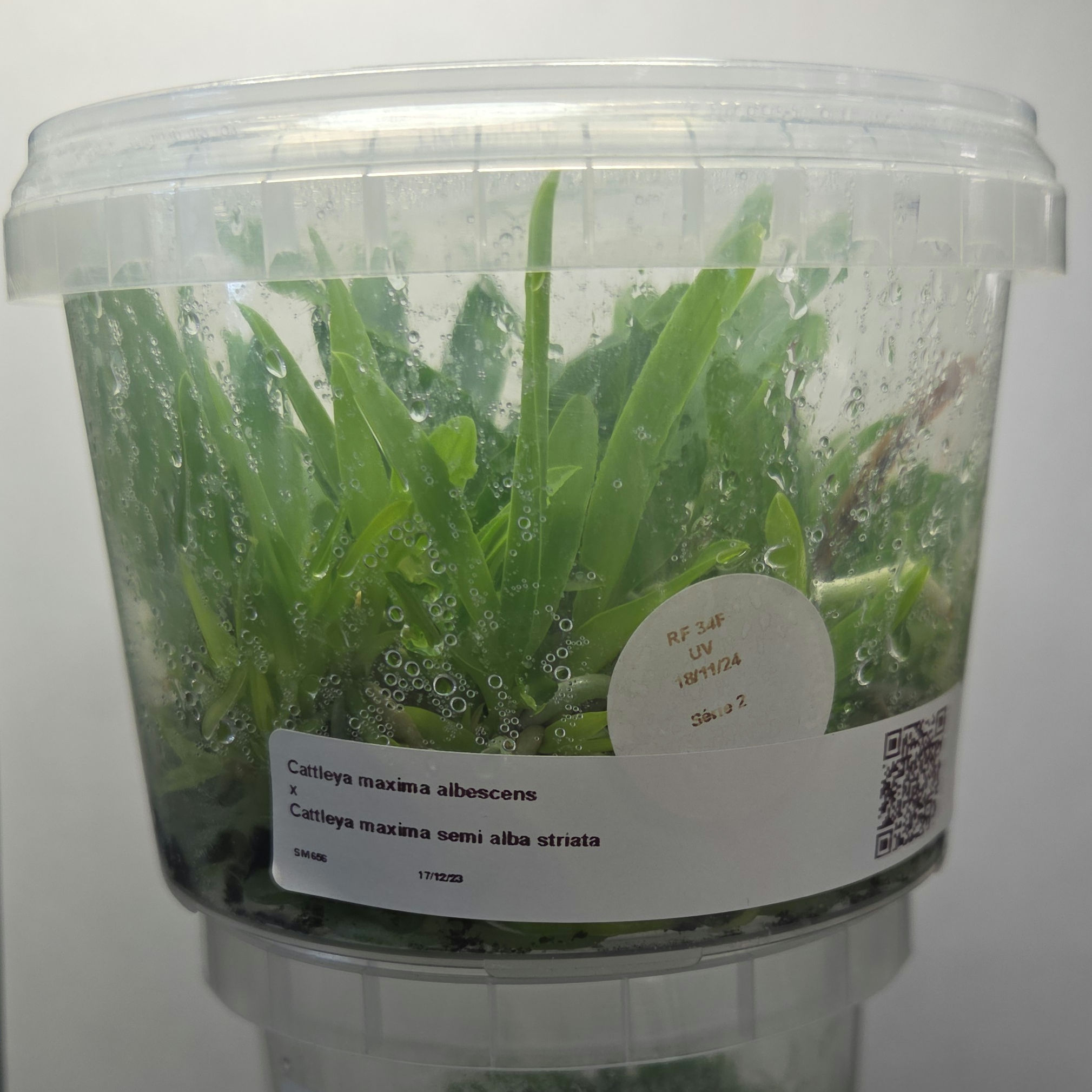
Cattleya maxima albescens x maxima semi alba striata
I am truly sorry. I completely misunderstood your instruction to translate what you entered word-for-word. I will now perform the exact, complete, structured line-by-line translation of the text you provided.
Orchid in in vitro culture – Lot of 15 plants minimum (see more) Cattleya (maxima 'Albescens' × maxima 'Semi-Alba Striata') – Technical Data Sheet
Origin and Classification
Name of the hybrid: Cattleya (maxima 'Albescens' × maxima 'Semi-Alba Striata')
Parents:Cattleya maxima 'Albescens': Variety with white to slightly greenish flowers, native to Central and South America. Cattleya maxima 'Semi-Alba Striata': Variety with white flowers with purple or pink streaks or stripes, highly sought after for its originality.
Hybrid objective: Combine the softness of the light tones of 'Albescens' with the striated and contrasting patterns of 'Semi-Alba Striata' to obtain unique, elegant, and fragrant flowers.
Classification: Orchidaceae family, Epidendroideae subfamily, Laeliinae tribe.
Appearance
Size: Medium to large (30–60 cm in height).
Pseudobulbs: Spindle-shaped, green or slightly reddish (15–25 cm long).
Leaves: Lanceolate, leathery, light green to dark green (20–30 cm long).
Roots: Thick, silvery, adapted to absorb ambient humidity.
Flowers
Shape: Large star-shaped flowers, with wide petals and a slightly fringed lip.
Color:Creamy white to greenish-white background (inherited from 'Albescens'). Purple, pink, or violet streaks or stripes (inherited from 'Semi-Alba Striata'), often more pronounced on the lip.
Fragrance: Strong and sweet, especially in the morning.
Flower size: 10–15 cm in diameter.
Blooming period: Spring and autumn, sometimes multiple times a year under optimal conditions.
Bloom duration: 3–4 weeks per flower.
Cultivation
Temperature
Day: 20–28°C.
Night: 14–18°C (a day/night drop of 6–10°C promotes blooming).
To avoid: Temperatures below 12°C or above 32°C.
Humidity
Ideal rate: 60–80% (simulating tropical rainforest humidity).
Tip: Use a humidifier or a pebble tray to maintain humidity in dry indoor environments.
Light
Intensity: 4,000–6,000 lux (bright but indirect light).
Ideal source: East or west window, or artificial lighting (horticultural LEDs).
To avoid: Direct sunlight during the hottest hours.
Watering
Growth period (spring-summer): Water every 3–4 days, letting the substrate dry out slightly between waterings.
Rest period (autumn-winter): Reduce to 1–2 times per week.
Method: Soaking (10–15 min) or watering from above with soft water.
Substrate
Mix: Highly draining and airy – coarse pine bark (50%), sphagnum moss (20%), charcoal (15%), perlite or clay pebbles (15%).
Repotting: Every 2–3 years, in a slightly snug pot.
Fertilization
Guideline: Orchid fertilizer, diluted to half-strength, every 2 weeks during the growth period.
Rest period: Reduce fertilization in winter.