
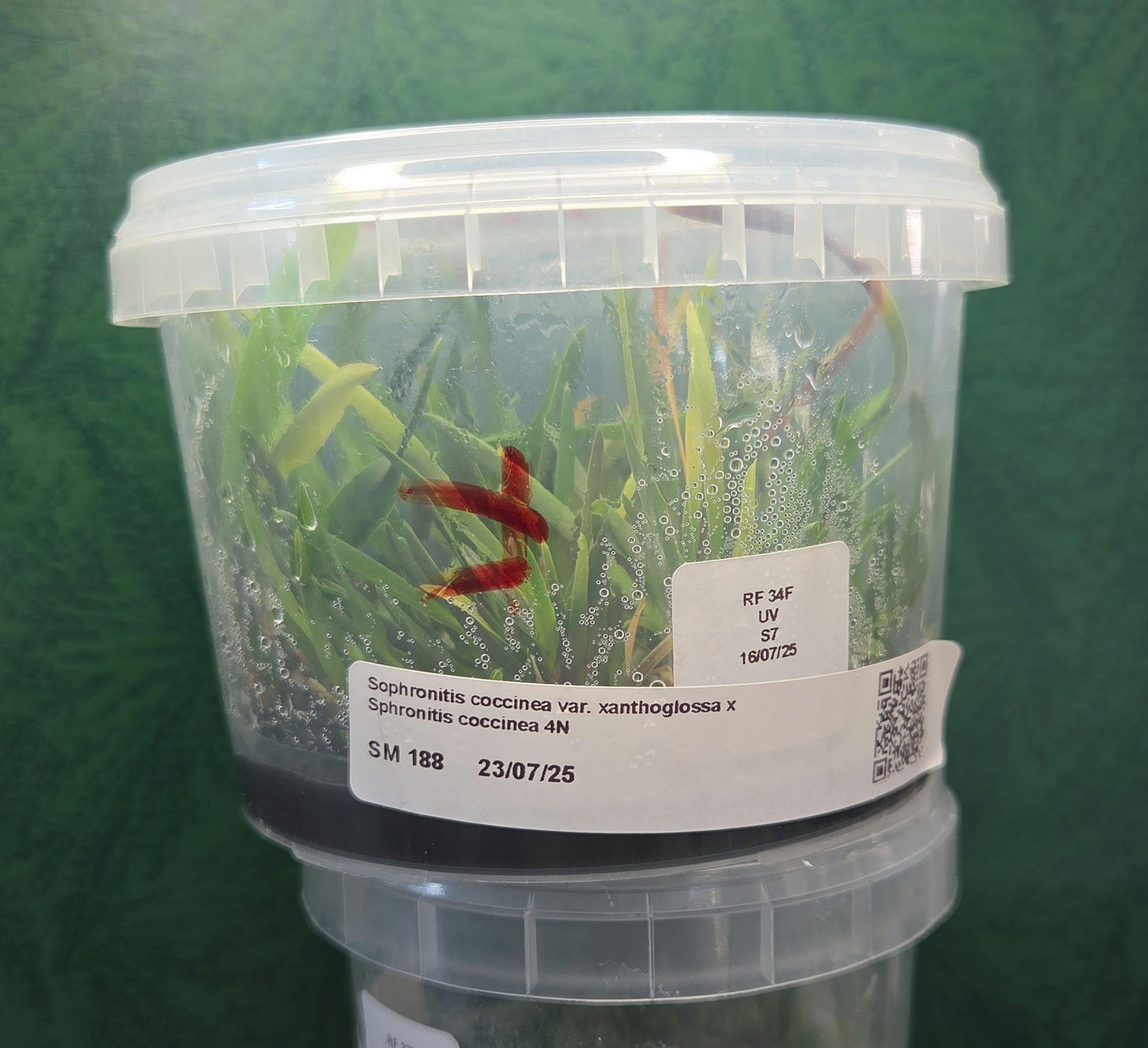
Cattleya / Sophronitis coccinea 4 N x wittigiana
In vitro pot containing a minimum of 15 plants (see more depending on the species)
Cattleya / Sophronitis coccinea 4N × Sophronitis wittigiana
(Tetraploid hybrid between two Sophronitis species, now classified under the genus Cattleya)
Origin and Classification
Type: Tetraploid (4N) artificial hybrid, resulting from the cross between:Cattleya coccinea (formerly Sophronitis coccinea): Brazil (states of Rio de Janeiro and São Paulo), scarlet flowers, small and compact. Cattleya wittigiana (formerly Sophronitis wittigiana): Brazil (Minas Gerais), pink to purple flowers, slightly larger.
Family: Orchidaceae (subfamily Epidendroideae, tribe Laeliinae).
Special feature: Tetraploid (4N) plants are more robust, with larger and more resilient flowers than diploid forms.
Appearance
Size: Compact to small orchid (15-30 cm in height).
Pseudobulbs: Small and ovoid (2-4 cm), reddish or dark green, clustered on a short rhizome.
Leaves: Lanceolate, leathery, dark green (5-10 cm long), 1 leaf per pseudobulb (characteristic of former Sophronitis species).
Roots: Fine and whitish, typical of epiphytic orchids.
Flowers
Shape: Flowers in terminal clusters (2-5 flowers per spike), small but highly colorful (3-5 cm in diameter). Broad and rounded petals and sepals, with a tubular and fringed lip.
Color: Scarlet red to bright pink (inherited from C. coccinea), sometimes with purple nuances (influence of C. wittigiana). The lip is often darker than the petals.
Fragrance: Light, slightly sweet.
Bloom duration: 2-3 weeks per flower, but the spike can bloom multiple times a year under good conditions.
Blooming period: Spring and autumn (multiple blooms possible if conditions are favorable).
Cultivation
Ideal Conditions
Climate
Temperature:Day: 18-25°C (avoid excessive heat). Night: 12-15°C (day/night drop is crucial for blooming). Minimum: 10°C (protect from frost).
Humidity: 60-70%. Use a humidifier or a pebble tray in dry indoor environments.
Light
Intensity: Bright but indirect light (50-70% shade).
To avoid: Direct sunlight (risk of leaf burns).
Ideal setup: East or west window with a sheer curtain, or under horticultural LEDs (12,000-15,000 lux).
Watering
Growth period (spring-summer): Daily watering or every 2 days (the substrate must remain slightly moist).
Winter rest (autumn-winter): Reduce to 2-3 times per week.
Method: Short soaking (5-10 min) or watering from above.
Substrate
Highly draining mix: Fine bark, sphagnum moss, charcoal, and perlite (50% bark, 30% sphagnum, 20% perlite).
Repotting: Every 1-2 years, in a small pot (these orchids prefer to be tightly potted).